Contents
Alarm Configuration
Create alarm rules that trigger notifications and actions when events occur.
Overview
Kalytera's alarm system lets you create rules that fire when specific events occur — a camera going offline, motion detected, storage running low, or an AI object crossing a virtual tripwire. The system supports 45+ trigger types across six categories.
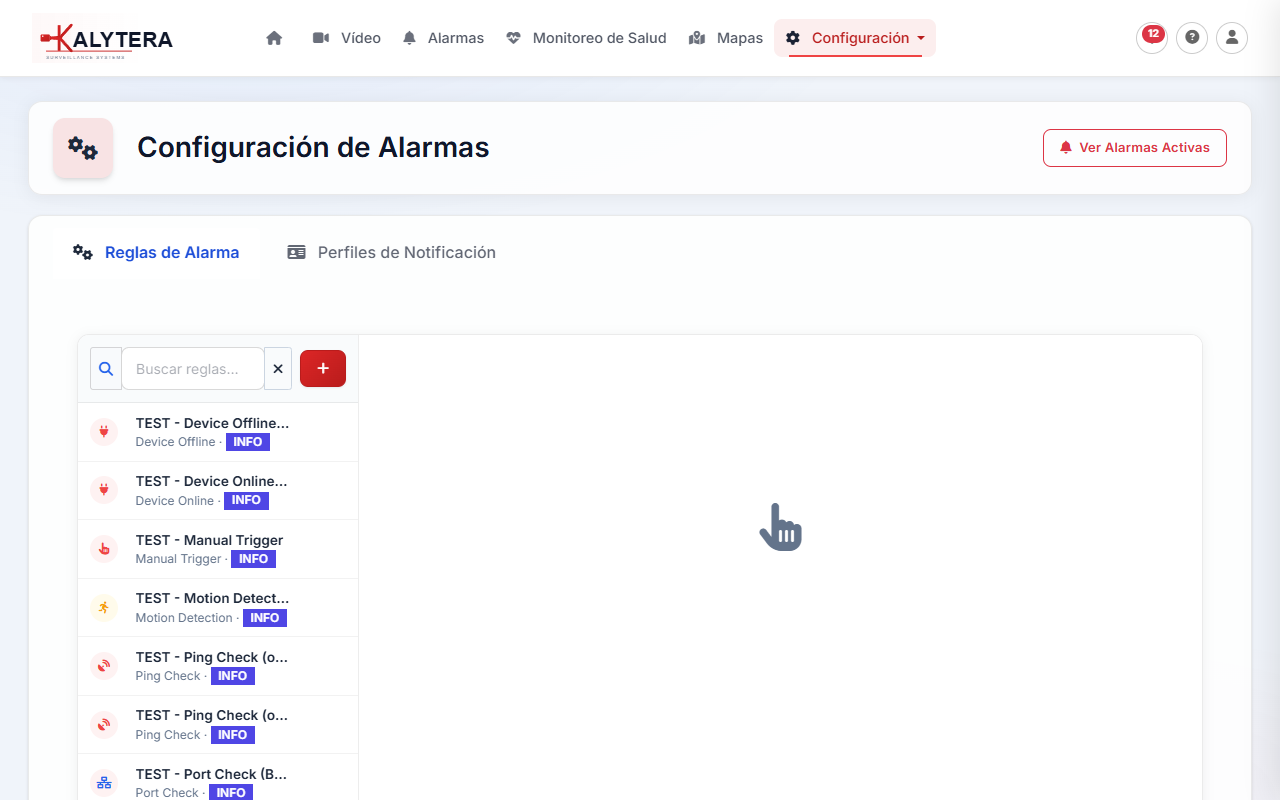
Configure alarm rules at Setup → Alarm Configuration. View active alarms under Alarms in the top navigation.
License requirement: Alarms and analytics are available on Standard edition and above. The Community Edition does not include the alarm system.
Predefined Alarm Templates
Kalytera includes 7 ready-to-use alarm templates you can activate with a single click:
| Template | Trigger | Default Action |
|---|---|---|
| Device Offline | Camera loses network connectivity | System notification |
| Motion Detection | Motion detected by the analytics engine | System notification + recording |
| Recording Stopped | Camera unexpectedly stops recording | System notification |
| Storage Low | Available storage falls below threshold | System notification |
| Video Tampering | Camera view is blocked, defocused, or redirected | System notification |
| Video Loss | Camera stream drops out completely | System notification |
| Stream Health | Stream quality score falls below threshold | System notification |
Click the Activate button next to any template to enable it with the default settings. The template creates a fully configured alarm rule that you can then edit to adjust thresholds and actions.
Custom Alarm Rules
Click New Rule to build a custom alarm from scratch:
- Name: Give the rule a descriptive name (e.g., Parking Lot — Person after 11pm).
- Trigger: Select the event type that fires the alarm (see Trigger Categories below).
- Target Devices: Choose which cameras or devices this rule monitors. Select All Devices for a system-wide rule.
- Schedule: Optionally restrict the rule to specific hours or days (e.g., only active Monday–Friday 8am–6pm).
- Actions: Define what happens when the rule fires (see Alarm Actions below).
- Click Save Rule.
Trigger Categories
Kalytera supports triggers across six categories:
- Device Health: Offline, rebooted, firmware changed, temperature exceeded, fan failure.
- Stream & Recording: Video loss, stream health score, recording stopped, disk write error, segment gap.
- Motion & Analytics: Motion detected, object detected (person/vehicle/animal), line crossing, area intrusion, object lingering, crowd detected.
- Storage: Drive usage exceeds %, drive missing, recording path inaccessible, retention pruning triggered.
- System: CPU overload, RAM critical, service restart, user login failure, unauthorized access attempt.
- External: Incoming SMTP alarm (from camera email alert), external webhook received, API-triggered alarm.
Analytics Triggers (AI)
Analytics-based triggers require AI analytics to be enabled for the target camera (Setup → Devices → Edit → Analytics). Available triggers include:
- Object Detected: Fires when an object of the specified class (person, car, truck, bicycle, etc.) appears in the frame.
- Line Crossing: Fires when an object crosses a user-defined virtual line in a specified direction.
- Area Intrusion: Fires when an object enters or lingers in a defined zone.
- Object Count Threshold: Fires when the number of detected objects exceeds a threshold (e.g., more than 5 people in a restricted area).
Combine Line Crossing triggers with a nighttime schedule to alert on perimeter breaches only after hours — preventing daytime false alarms from normal foot traffic.
Alarm Actions
Each alarm rule can trigger one or more actions when it fires:
| Action | Description |
|---|---|
| System Notification | Shows an alert in the Alarms panel in the UI (visible to all logged-in users). |
| Email Notification | Sends an email to one or more addresses. Requires SMTP to be configured in Admin → System. |
| Webhook | Sends an HTTP POST with alarm details to an external URL (e.g., Slack, Teams, custom integration). |
| Start Recording | Triggers a manual recording on the target camera for a configured duration. |
| Mobile Push | Sends a push notification to paired mobile devices (requires the Kalytera mobile app). |
Viewing Active Alarms
Active alarms are displayed in the Alarms section of the navigation. The alarm list shows when each alarm fired, which device triggered it, the severity level, and the current state (Active / Acknowledged / Resolved).
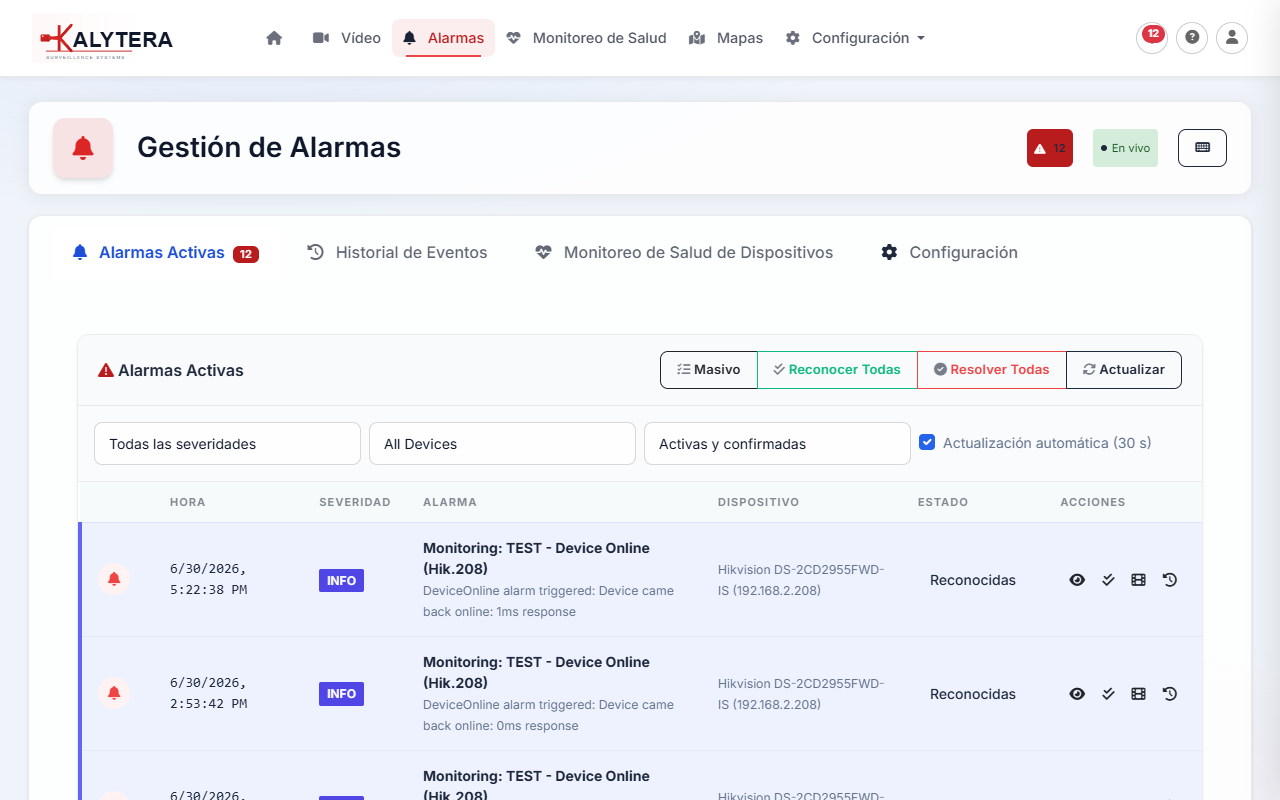
Click Acknowledge on an alarm to mark it as reviewed. Alarms auto-resolve when the underlying condition clears (e.g., camera comes back online).